



.jpg)


Every year, over 100 billion animals are raised and slaughtered for food. The overwhelming majority of them, roughly 99% in the United States and more than 90% globally, spend their entire lives inside factory farms.
Yet for most people, this system is nearly invisible.
Our food arrives neatly packaged, often branded with images of red barns, open pastures, and happy animals that bear little resemblance to how most meat, dairy, and eggs are actually produced. Between the farm and the shopping cart, an enormous industrial system operates largely out of sight.
Understanding how that system works is the first step toward understanding many of today's biggest environmental, public health, and animal welfare challenges.
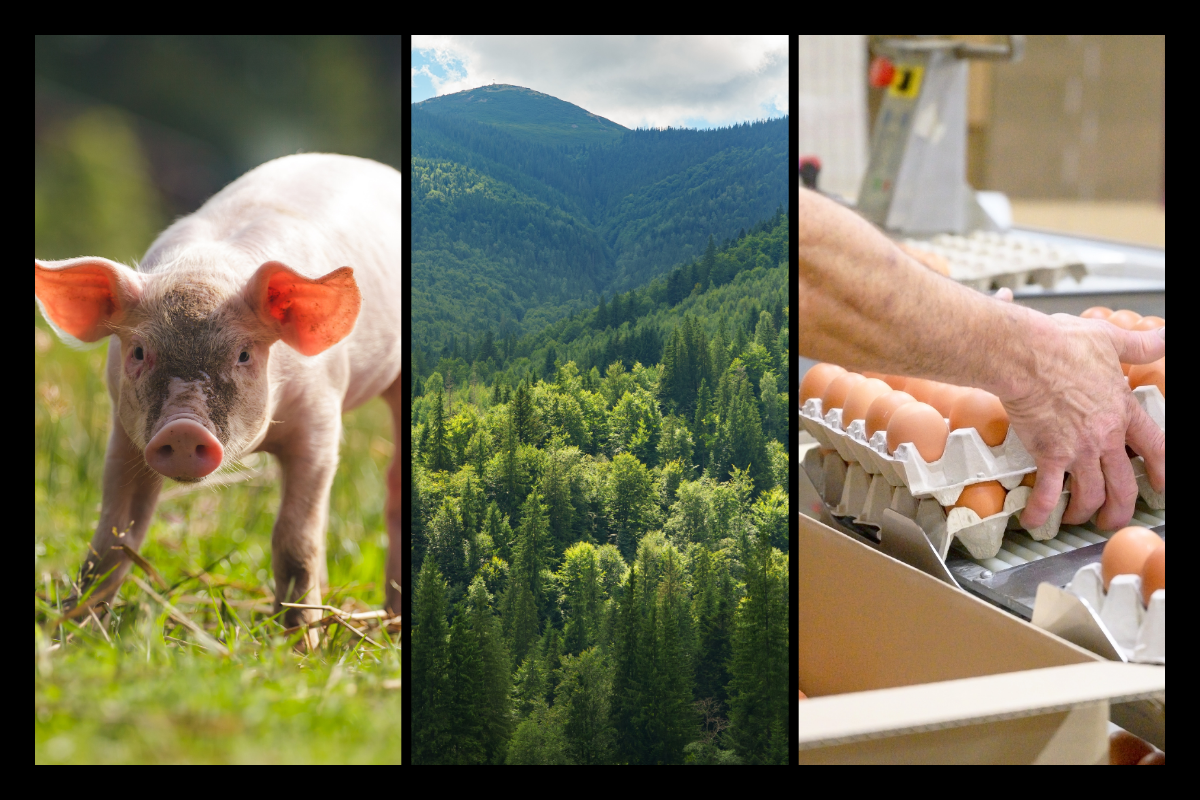
Factory farming, also known as industrial animal agriculture, is the practice of raising animals in large-scale, high-density operations designed to maximize efficiency, output, and profit.
.jpg)
In these systems, animals such as chickens, pigs, cows, and fish are typically raised in intensive confinement using standardized industrial processes that prioritize production at scale.
Factory farming didn’t always dominate food production.
Over the last century, a series of technological, economic, and policy changes transformed animal agriculture from mostly small family farms into one of the largest industrial systems.
Advances in transportation made it possible to move meat across long distances. New veterinary practices and antibiotics allowed animals to be raised in increasingly confined conditions. Government policies made feed crops cheaper to produce, while corporate consolidation enabled large companies to control every stage of production.
Together, these changes dramatically reduced the cost of animal products while concentrating more animals into fewer, larger facilities.
In the United States alone, 99% of U.S. farmed animals are raised in factory farms—over 10 billion animals.
Of the animals raised for food in the United States in 2022:
Over 21,000 CAFOs are operating across the United States, alongside more than 24,000 factory farms across Europe.
Maintaining a system of this scale also requires enormous financial investment. In 2024, multilateral finance institutions invested approximately $1.23 billion into the industrial meat and dairy industry, including funding from the World Bank Group, the European Investment Bank, and the U.S. Development Finance Corporation.
Although practices vary by species and facility, most factory farms follow the same basic model:
Breeding for efficiency: Animals are selectively bred to grow faster and produce more meat, milk, or eggs in less time, often with serious consequences to their health.
Confinement at scale: Animals are housed in high-density environments, often in systems such as battery cages or indoor barns with little to no access to natural light, fresh air, or outdoor spaces. Because disease can spread quickly in these conditions, producers often rely on vaccines, biosecurity measures, and antibiotics to maintain animal health and prevent outbreaks.

Industrial feed production: Animals are primarily fed crops like corn and soy, grown at industrial scale using synthetic fertilizers and pesticides, contributing to their own set of environmental harms.
Processing and distribution: Animals are transported in large numbers, often over long distances, to centralized, high-speed slaughter and processing facilities before products are distributed through national and global supply chains.
This system is optimized for volume and cost. But those efficiencies come with significant tradeoffs for animals, public health, workers, communities, and the environment.
New Roots Institute is a nonprofit empowering the next generation with knowledge and training to end factory farming. Through our leadership development programs, fellows take what they learn about the food system and put it into practice by launching campaigns that challenge industrial animal agriculture. We are strengthening the movement—spreading change from individuals to their communities, and expanding outward into wider systems-level change.


.jpg)

.png)