


New Roots Institute alum Arpi Keshishian spent two years building relationships, collecting data, and advocating for accessible plant-based options at UC San Diego. In 2025, the university made history as the first UC campus to eliminate its plant-based milk upcharge.


In 2025, the University of California San Diego eliminated the $0.60 upcharge on plant-based milks across campus, a change that impacts 60,000+ students and employees.
Sixty cents may sound small, but any barrier removed is an invitation extended: to students who are lactose intolerant, to those who choose plant-based options for environmental or ethical reasons, or to anyone who shouldn’t have to pay a penalty for making a sustainable choice.
This change didn’t happen overnight.
It happened because New Roots Institute alum and UC San Diego sustainability advocate, Arpi Keshishian, stayed persistent for more than two years.
Institutional change and effective food systems advocacy rarely happen alone.
The foundation Arpi brought to her UCSD campaign was shaped, in part, by her experience as a New Roots Institute fellow, where she learned about default plant-based milk campaigns and the broader strategy behind food systems change.
This is exactly what New Roots Institute is built to do: equip students with the tools, strategy, and confidence to challenge industrial animal agriculture and create a more just and sustainable future.
In 2023, Arpi launched the plant-based milk campaign through her sustainability position at UC San Diego. Her focus was clear: the environmental benefits of plant-based milk, particularly around water use and greenhouse gas emissions.
From the start, she took a data-first approach.
Rather than relying on general statistics, she partnered with UCSD’s dining business analyst to collect campus-specific coffee order data and model UCSD’s own environmental impact. What they found made it clear that expanding non-dairy milk usage would have drastic environmental benefits.
She had compelling evidence. She had allies on the dining staff. But in 2023, leadership chose not to move forward. The upcharge stayed.
Anyone who has tried to change policy at a large institution knows the particular exhaustion of waiting. Arpi was no stranger to it, “advocating for any change at a large university can be difficult, and I was fighting for a big shift - something that was never done by any UC [University of California campus].”
She didn’t interpret the 2023 setback as a permanent ‘no.’ She recalibrated. Arpi shared that “having a strong ‘why’ helped me stay focused for the long run. I was very passionate and consistent about making plant milk more accessible.”
That clarity of purpose is what often separates advocates who quit from those who persist. Arpi chose persistence, and she got strategic by focusing on relationship-building, incremental progress, and staying steady when momentum was hard to see.
From 2023 to 2025, Arpi kept the campaign alive through two complementary channels: her role as a campus EcoNaut in the UCSD Housing, Dining, Hospitality Sustainability department, and a fellowship with the UC Office of the President’s Global Food Initiative Program, which focused on sustainable procurement across the UC system.
To help gain support for her work, she hosted tabling events, created social media campaigns with UCSD dining, led plant-based cooking and food tasting events, and incorporated plant-based dairy education into her team’s programming.
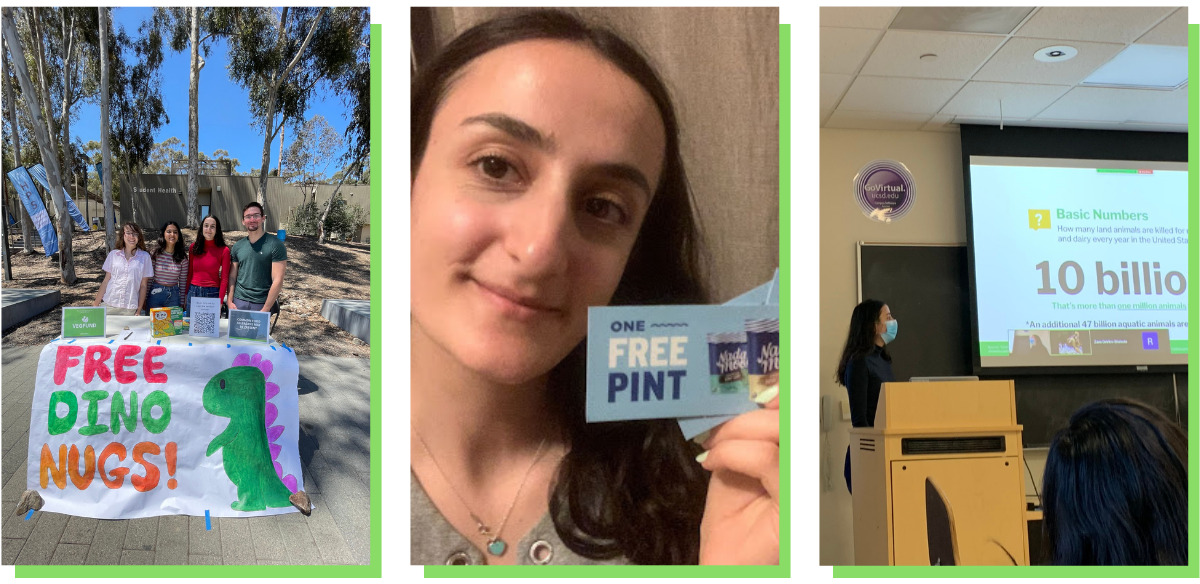
Her advocacy efforts were both practical and values-driven:
On campus, Arpi’s most important partner was UCSD’s dining business analyst, someone she credits as essential to making the change possible.
She also worked closely with the dining sustainability team, a group she had invested three years building trust with, and a sustainability coordinator deeply committed to water conservation.
By mapping her campaign to existing institutional values and building genuine relationships across departments, she created the conditions for a ‘yes.’
The pivotal moment came in Summer 2025, when the dining analyst revisited the numbers.
Two things had changed: the cost of oat milk had dropped, and Peet’s Coffee, UCSD’s primary supplier, had stopped charging extra for plant-based milk. For the first time, the economics aligned with the mission.
After further discussions with dining leadership, the decision was made. UCSD would eliminate the plant-based milk upcharge after two years of groundwork had created the conditions for change.
Removing a surcharge at one campus may seem modest in the scope of food systems change, but that’s not how precedent-setting works.
No UC campus had done this before Arpi’s campaign. Now one has. And that matters to every sustainability advocate, dining director, and student government representative watching.
The question is no longer whether it’s possible. It’s who’s next. As Arpi put it, “with this win, we are one step closer to a plant-forward future.”
Now graduated from UC San Diego, Arpi isn’t stepping back from food systems work. She hopes to continue advocating for a just and sustainable food system and build a career that contributes to that mission.
Her advice for advocates navigating the slow work of institutional change? “Be patient and understanding with the university or institution you are working with. Oftentimes, making these changes can be complicated for a large institution, and may take a while. Stay in it for the long-run, build strong relationships with leadership, and collaborate with organizations, departments, and students who support the initiative.”
Arpi also shared the importance of taking a break when motivation fades, and to keep short-term goals in view alongside the larger campaign to sustain momentum.
Slow change is still change. And sometimes, two years of steady work is exactly what it takes.
Arpi Keshishian is a New Roots Institute alum who graduated from UC San Diego in 2025 with a B.S. in Political Science & Data Analytics, a B.A. in Global Health, and a minor in Climate Change Studies. Read her previous post on adding plant-based options to school lunch policies.
New Roots Institute is a nonprofit empowering the next generation with knowledge and training to end factory farming. Through our leadership development programs, fellows take what they learn about the food system and put it into practice by launching campaigns that challenge industrial animal agriculture. We are strengthening the movement—spreading change from individuals to their communities, and expanding outward into wider systems-level change.