




Did You Know?
Want More Factory Farming Facts?


75%-86% of all plastic in the Great Pacific Garbage Patch is from fishing waste. (April 2022)
Source →
Between 2000 and 2013, approximately 63% of deforestation in the Brazilian Amazon was due to cattle and feed crops. (April 2017)
Source →
15.4% of global greenhouse gas emissions come from animal agriculture, comparable to all transportation (cars, trucks, trains, planes) combined. (Dec 2020)
Source →
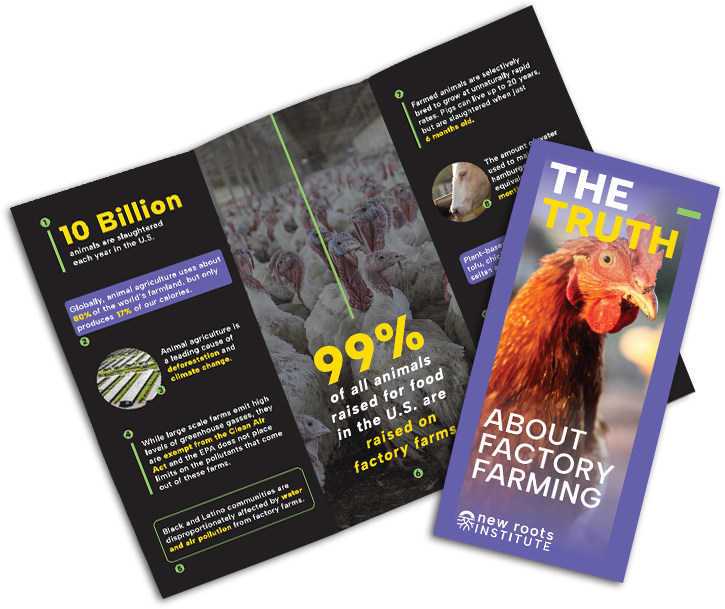
Globally, animal agriculture uses about 77% of the world's farmland, but only produces 18% of our calories. (Feb 2024)
Source →
It takes about
1800 gallons of water to produce one pound of beef
, which translates to around 450 gallons for a quarter-pound hamburger. (April 2020)According to Project Drawdown, the two biggest options (out of 100 ranked options) to reduce our greenhouse gas emissions are Reducing Food Waste and Plant-Rich Diets.
Source →
10 billion animals are slaughtered each year in the US. 99% of them are raised on factory farms. (Oct 2024)
Source →
There are 97 million more animals (6.1%) living on factory farms than five years ago, and 46.9 percent more than 20 years ago. (Sept 2024)
Source →
On industrial dairy farms, newborn calves are separated from their mothers within 24 hours after birth, leading to signs of distress in both cow and calf.
Source →
Disbudding is the removal of horn buds in young calves, typically under two months old, using methods like burning, caustic paste, or surgery. It’s intended to reduce injuries among animals and handlers in intensive farming operations. However, even with pain relief, calves often continue to show signs of pain and discomfort after the procedure.
Source →
In battery cages, four or more hens are crammed into wire enclosures so tight they are unable to spread their wings. This extreme confinement leads to stress-related behaviors like pecking at each other.
Source →
Throughout their pregnancies, pigs are often kept in gestation crates—narrow metal enclosures barely large enough to hold their bodies. With no room to turn around, they frequently develop abnormal behaviors, leg issues, bladder infections, and skin wounds.
Source →
According to the USDA, there are 800 federally inspected slaughterhouses in the United States. And we slaughter one million animals an hour, making the line speeds incredibly fast (creating significant injury risks for workers as well as severely increasing concerns for animals going through the system).
Source →
Factory farms are currently exempt from reporting hazardous air emissions from animal waste. (Sept 2024)
Source →
About 70% of antibiotics worldwide are fed to farmed animals. Antimicrobial resistance is listed by the WHO as among the top 10 threats to global health. (April 2025)
Source →
Each year, 1.7 million animals raised on factory farms generate around 941 billion pounds of waste, which is twice as much as the total amount of human sewage produced annually by the entire U.S. population. This manure is often dumped untreated into the environment, where it pollutes water sources and endangers public health. (Sept 2024)
Source →
On factory farms, untreated animal waste is stored in large, open-air lagoons containing feces, urine, blood, feces, pathogens, and pharmaceuticals. Runoff from these pits contaminates groundwater, rivers, and streams, posing extreme health risks to nearby communities.
Source →
Factory farms are often built near communities of color and low income communities. In rural North Carolina, predominantly Black communities are, on average, situated four times closer to industrial pig farms than predominantly white communities.
Source →
People of color, immigrants, and people in relatively low-income families are disproportionately employed in meatpacking plants. Almost one-half (44.4 percent) of meatpacking workers are Hispanic, and one-quarter (25.2 percent) are Black. (April 2020)
Source →
US meat workers are already three times more likely to suffer serious injury than the average American worker, and pork and beef workers are nearly seven times more likely to suffer repetitive strain injuries. Records compiled by the Occupational Safety and Health Administration (OSHA) reveal that, on average, there are at least 17 “severe” incidents a month in US meat plants. These injuries are classified as those involving “hospitalisations, amputations or loss of an eye.” (July 2018)
Source →
Four corporations control 73% of beef production, 67% of pig production, and 54% of chicken production. As a result, more than half a million pig farmers have gone out of business in the past 25 years. (Oct 2020)
Source →